

RADar Challenge
June 24 - July 23, 2025
In an increasingly complex and uncertain context, marked by intertwined climate, geopolitical, health, digital, and economic crises, national defense can no longer rely solely on sovereign domains. Mobilizing society as a whole has become strategic.


The Challenge consists of responding to the following issue:
What role will civil society play in defense in 2035?
How can it be mobilized? How important is it?




Instructions:
Imagine the role of civil society in 2035 in defending tomorrow, in areas such as the armed forces, the defense industry, innovation, and research.
Write your idea in the form by clicking on “I'm participating.” There is a 2,500-character limit.
Fill out the form with the requested information before sending it.
Submit your proposal before midnight on July 23.
Be authentic, creative, and innovative!
A jury composed of members of the RADAR Club team will select the best ideas.
Terms and conditions of participation
-
Challenge open to all
-
Possibility to respond alone or in a group (max. 5 people)
To be won:
An illustration of your concept
created by a professional illustrator

An official invitation
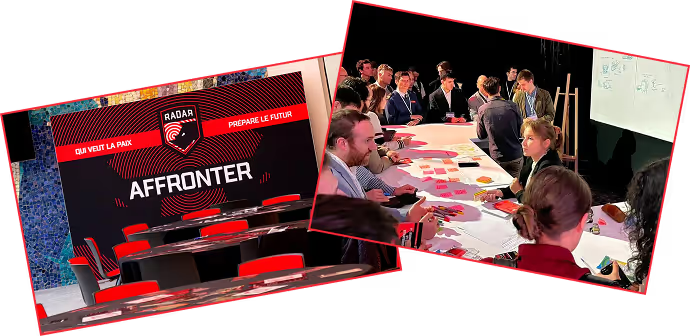
to participate in a workshop on defense forecasting and strategic anticipation organized by the RADAR Club
A guided tour of the FID
(Defense Innovation Forum) with the RADAR team, at the end of 2025

Lots of exclusive goodies


The winning answers:
an app for collective mobilization
in local associations
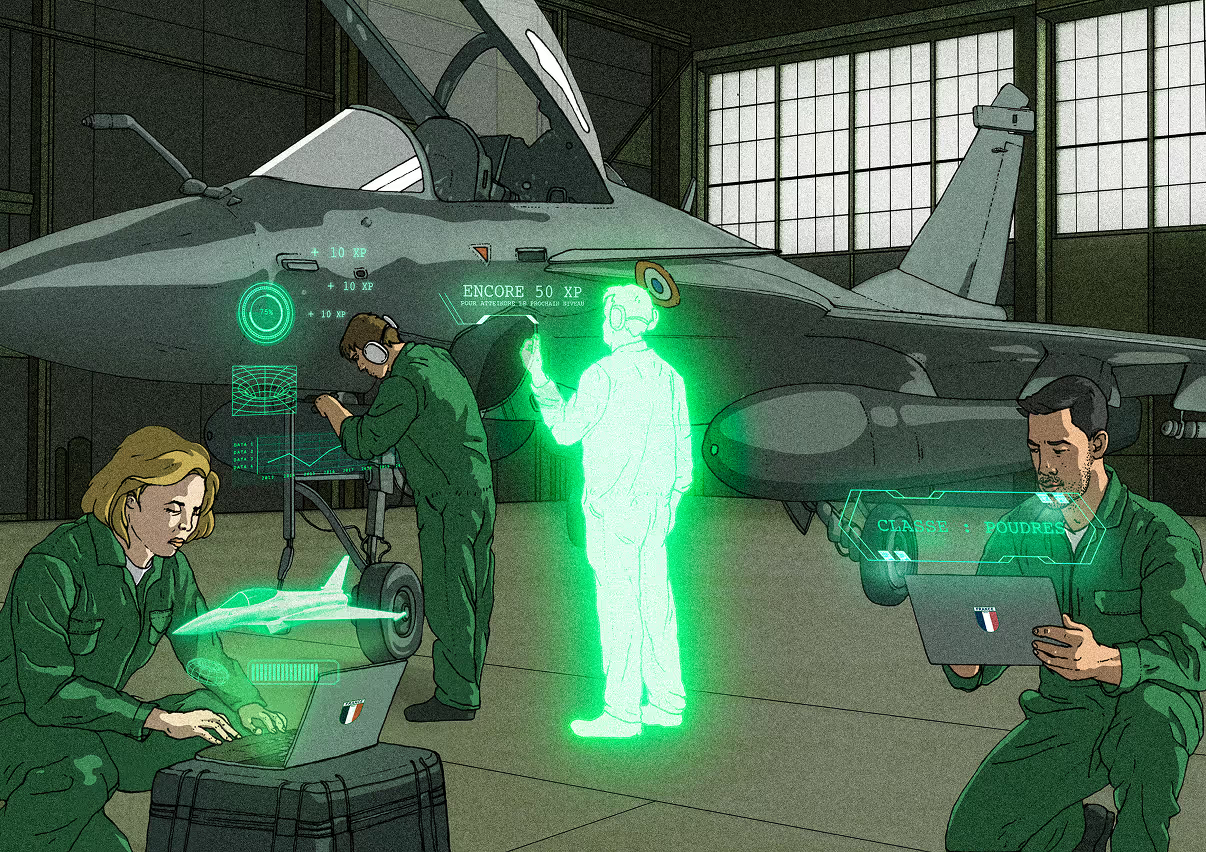
2035. The government releases G.A.R.D.I.E.N*, an MMORPG game app with real-life implications. Defense and Citizenship Day is moved up to age 16 to allow young people to start playing. Each teenager must choose an avatar and a class that will guide their development in the game and in society.
The time invested in real-life classroom activities is converted into experience points (XP), which can be used to acquire equipment and bonuses for your avatar. Side quests may be offered to meet specific needs.
To ensure that this effort is not based solely on the appeal of video games, the government is introducing benefits directly linked to the level of the player's avatar. Players can unlock university credits, tax breaks, and more.
Each individual is required to pass at least one level per year for at least 10 years.
Thus, G.A.R.D.I.E.N (the Autonomous Group for Resilience and Integrated Defense Committed to the Nation) covers the wide range of defense needs through its five classes.
Blade Class: Territorial Defense.
Players who choose this class will undergo military training and will be directly integrated into the combat reserve. A shooting proficiency certificate = 10 XP One week of field training = 25 XP One exercise = 50 XP
Enlightenment Class: Influence.
Players who choose this class will be responsible for fact checking, monitoring, and influencing. 1 hour of monitoring = 15 XP 1 fact-checked video = 15 XP 1 influence operation = 50 XP
Powder Class: Industrial Resilience.
Players who choose this class strengthen the industrial and technological defense base (BITD). It covers both R&D and production. One hour of production = 25 XP Participation in a project = 35 XP
Seed Class: Civil Protection.
Players who choose this class protect populations from increasingly violent weather events. Participation in event safety = 15 XP One hour of awareness-raising or training = 10 XP Population evacuation, forest fires = 100 XP
*Autonomous Group for Resilience and Integrated Defense Committed to the Nation
By Lea C.
The reflections gathered here do not reflect the official position of the Ministry of the Armed Forces or that of the French government.
We have become techno-humans.
It is a driving force but also our weakness, in many respects .
The interference of external powers, both private and state-run, in our smartphones, via social networks, is increasingly demonstrating its harmful effects on:
- the health of young people,
- the cohesion of the nation, which is becoming increasingly polarized and individualistic,
- our brains are softening, partly because of this digital drug.
In the event of a large-scale digital or cyber attack, we would be forced to return to our primary informational tool: human interaction and verbal communication.
Beyond digital means, in the event of a physical attack on our territory, our ability to communicate with each other, on the scale of a neighborhood, a building, a village, remains paramount.
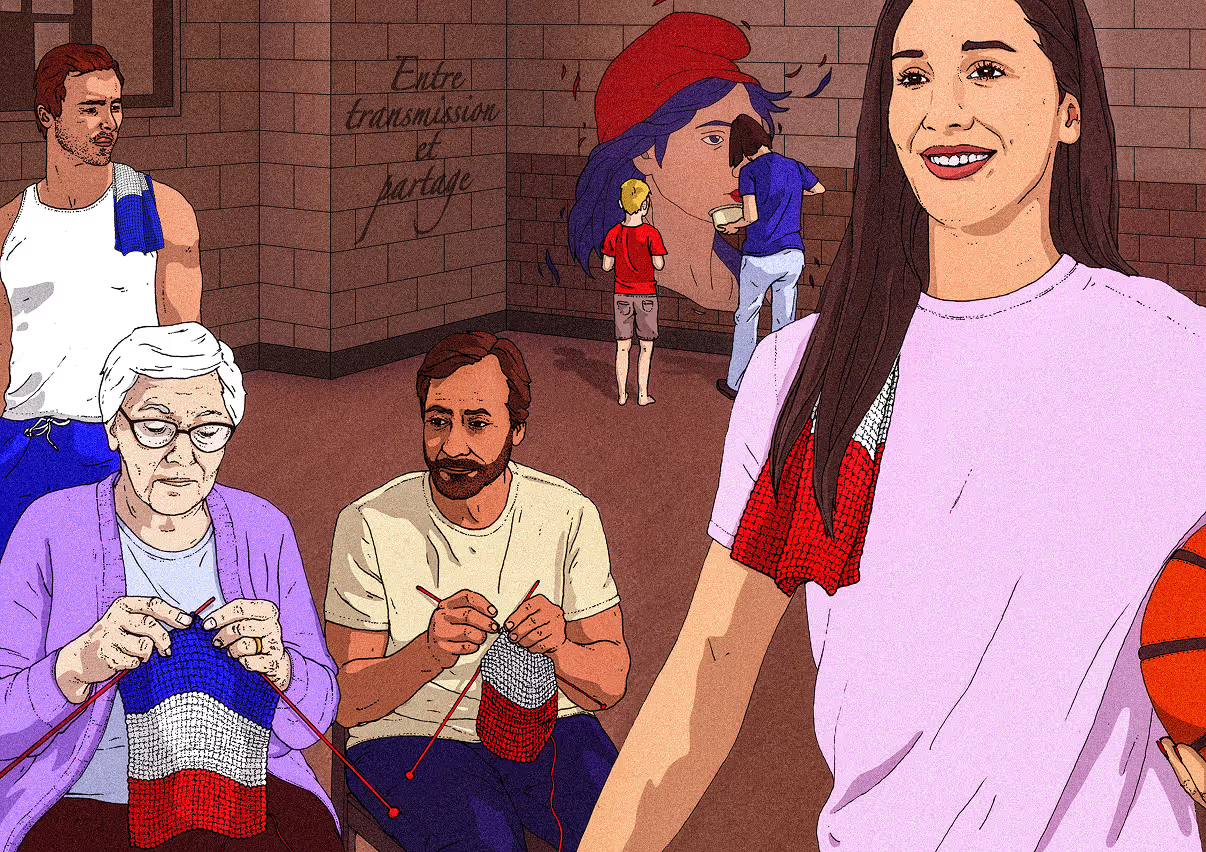
The good news is that resistance networks already exist. They are none other than associations, mainly made up of volunteers.
More than one in three French people are members of a sports association that they attend regularly. The club—whether for football, tennis, or karate—is a place recognized by everyone, at the heart of the village or neighborhood. It's a non-political community bound by a common project and shared values.
Other existing associations include private co-ownerships which are managed by management boards and their volunteers.
The proposal is to create a network of defence liaisons within these ultra-local associations.
But here, there is no need to develop a reserve as such.
These are individuals trained for a few hours by the armed forces, capable of acting as a bridge between military values and methods and the members of the association they work for. All of this is done on a voluntary basis. And above all, without using fear-mongering, but rather by transmitting skills to build trust.
Their role:
1) To develop a culture of defense and security among the association's members by providing them with a methodology for responding to an attack. They could teach members how to create their own survival kit or teach life-saving techniques, similar to first aid.
2) To act as an information relay in peacetime and in the event of an attack.
3) To inspire military vocations (active duty or reserve).
By Laure G.
The reflections gathered here do not reflect the official position of the Ministry of the Armed Forces or that of the French government.
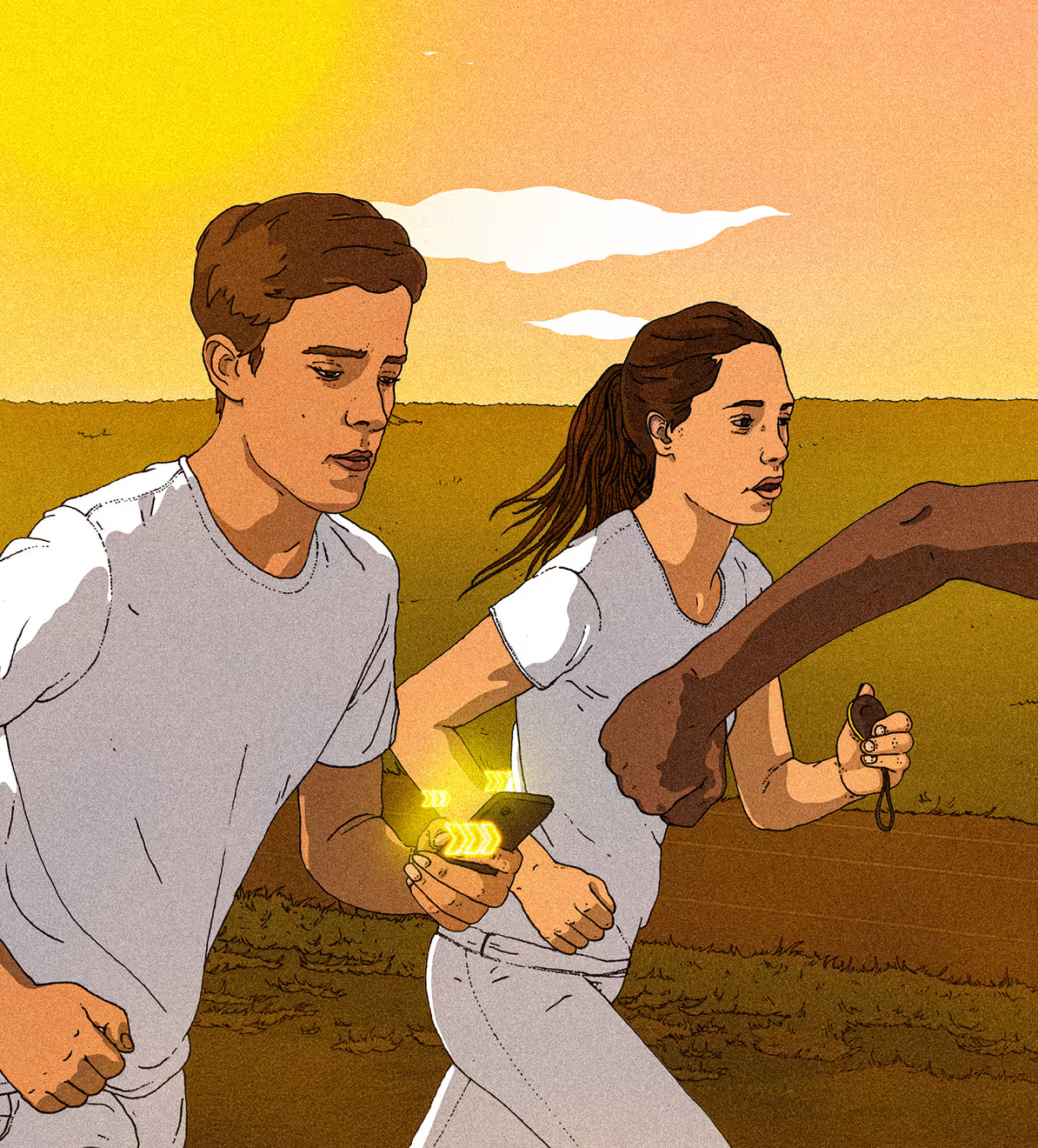
The idea below stems from the jury's merging of two complementary ideas:
A civil society engaged and prepared to work alongside the armed forces by 2035
Faced with the rise of hybrid threats—cyber, information, terrorist, or environmental—defense can no longer be considered the exclusive domain of the armed forces. It must become a shared culture, integrated into the daily lives of citizens, and conceived as a collective discipline of resilience and strategic preparedness.
In 2035, this mobilization will take two complementary forms: sport and civic defense training.
Sport as a vehicle for social cohesion and the link between the armed forces and the nation
- Children will benefit, both during and outside of school hours, from sports classes and activities supervised by military personnel, such as orienteering or strategy video games.
- Teenagers will have access to video games developed in partnership between the armed forces and French companies, promoting both strategic thinking and awareness of defense.
- Adults will benefit from free weekly street workout classes offered across the country by military personnel, while military hospitals will open their Adapted Physical Activity (APA) programs to civilians.
A mandatory operational reserve structured by training
All citizens of the European Union residing in France, aged 16 to 50, will join a mandatory operational reserve, adapted to the profile of each individual through training platforms and artificial intelligence.
- A common platform for European Union countries will offer MOOCs and face-to-face training, allowing citizens to acquire and certify skills via open badges integrated into their Europass CV.
- European skills mapping and artificial intelligence will ensure an optimal match between civilian expertise and reserve missions.
The National Civil Readiness Index (INPC): Measuring and Recognizing Commitment.
From the age of 18, every citizen will take the INPC, a standardized test assessing their ability to serve their country in times of crisis (digital hygiene, knowledge of institutions, resilience, public service ethos, etc.). Based on short, flexible training (10 to 20 hours online, in-person, or hybrid), this score out of 1,000 points will gradually become essential for joining certain government agencies, sensitive companies, or prestigious universities, similar to the TOEFL or PIX.
The governance of this system would be entrusted to a National Institute for Civilian Preparation, attached to the Ministry of the Armed Forces, responsible for designing training programs, administering tests, and issuing certifications. The new-generation Defense and Citizenship Day would constitute a mandatory first step, encouraging everyone to progress in their preparation journey.
…
By combining sport, training, the operational reserve, and skills certification, civil society will be fully integrated into national defense. This sustained, structured, and valued mobilization will make the armed forces-nation link a pillar of social cohesion and guarantee France's democratic resilience in the face of the challenges of 2035.
...
A fusion of the concepts of Claire B. and Jade B.
The reflections gathered here do not reflect the official position of the Ministry of the Armed Forces or that of the French government.
+120
Participations
11
Sectors of activity represented among participants*
30
Days of reflection to participate
*Defense / Security / Military - Government / Public Institutions / Administration - Industry / Aeronautics / Industrial Defense - Consulting / Business Services - Freelancers / Independent Contractors / Consultants - Research / Innovation / Think Tanks - Higher Education / Education / Students - Technology / Digital / Tech Innovation - Banking / Insurance / Finance - Commerce / Distribution - Culture / Media / Audiovisual


